
For warehouse professionals, understanding the actual cost of a warehouse management system is essential before investing in software. Not all warehouse management solutions are priced comparably; costs vary depending not only on the solution but also on business size, the complexity of warehouse operations, and the required functionality. When accounting for the cash price of your investment, you should also consider implementation costs, hardware, integrations with ERP or CRM systems, and ongoing support.
Our latest guide breaks down average warehouse management system cost by business size, explores the factors that influence WMS pricing, and shows how to calculate ROI on your investment. We’ll also explain how Sortly inventory software offers cost-effective warehouse inventory management that’s ideal for many small businesses.
What’s the average warehouse management system cost?
The average cost of warehouse management software depends on the scale of your operation. In 2026, businesses spend anywhere between $600 and $150,000 a year on warehouse management software. As you might expect, the costs are highly variable depending on the solution, the size of the business, how customized and advanced the technology is, and how many user licenses are needed.
It is important to note that Sortly is not a warehouse management system. Sortly is warehouse inventory management software designed to help warehouse businesses track everything in their warehouses: inventory, supplies, assets, tools and equipment, and even work-in-progress inventory. It helps businesses optimize inventory levels while managing holding costs and streamlining workflows.
For SMBs, Sortly provides many of the benefits of WMS solutions at a fraction of the overall cost, even offering free plans for small businesses that require limited functionality and only one user seat.
This easy, comprehensive guide will help you:
Free Ebook: Getting Started With Inventory Tracking
5 factors that influence the cost of warehouse management software
When evaluating WMS software costs (and inventory software costs), consider the following elements that contribute to the total cost of ownership.
1. Features
Advanced features such as barcoding, forecasting, and even robotics integrations increase pricing. Systems with end-to-end supply chain functionality are priced higher than those focused primarily on inventory tracking.
2. Number of user licenses
Many WMS solutions are priced by the number of users. As your team grows, license fees and subscription fees can add up quickly, so make sure you plan for your own growth when selecting a WMS.
3. Number of locations
Some cloud-based WMS solutions are priced for a single warehouse, while others charge per location. Businesses managing multiple warehouses should factor this into their budget and selection.
4. Set-up or implementation costs
Implementation costs, including configuration, training, and data migration, can represent a significant initial cost. On-premise WMS systems often require more IT infrastructure and even in-house IT staff, while cloud-based software typically carries fewer initial costs.
5. Integration, hardware, and ongoing support
Your WMS won’t exist in a vacuum. Related costs may include physical items like handheld barcode scanners, tablets, and RFID tags, as well as the costs to integrate the WMS with your ERP or even accounting software. Ongoing costs like annual maintenance or upgrades should also be factored in.

Calculating the ROI of a warehouse management system
Understanding pricing is only half the equation—your WMS should ultimately boost efficiency and drive a return on investment (ROI) for your business. Here’s how you can estimate ROI for a warehouse management system:
Quantify expected efficiency gains
A WMS system can streamline warehouse operations, reducing cycle times and improving throughput. Modeling these gains helps quantify value.
Measure time and labor saved
Automation from a good warehouse system reduces time spent on manual inventory management, order processing, and putaway. Labor savings can be substantial, especially for larger business operations.
Estimate error reduction benefits and payback period
Reducing errors in picking, packing, and order fulfillment lowers costs associated with returns and lost sales. Many businesses achieve payback within 12 to 24 months.
Consider the value of Sortly’s warehouse inventory system
Sortly helps businesses save time and cut costs by streamlining operations and giving you real-time visibility. You get all the power without the high cost, massive time commitment, or often-unnecessary complexity of traditional warehouse management systems.
Our survey data shows that warehouse inefficiencies—like wasted labor, lost materials, and over-ordering—can cost businesses up to $47,000 annually. That’s why an easy, flexible solution that tackles these pain points directly can be a game-changer.
With smart features like mobile barcode scanning, low stock alerts, pick lists, and even purchase order generation, Sortly eliminates the hours spent searching for items, minimizes replacement costs, and puts a stop to overstocking. Every hour saved in the warehouse translates directly to real operational savings, making Sortly a smart solution for warehouse businesses ready to optimize inventory management without the WMS headache or cost.
Use Sortly to help manage your warehouse
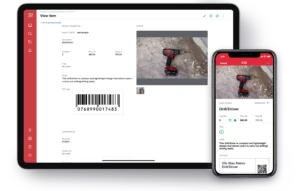
While WMS solutions can be costly and complex, Sortly offers an easier, smarter way to manage warehouse inventory. Sortly empowers warehouses of all sizes to achieve scalability and operational efficiency without the overhead of perpetual license fees or on-premise systems, making it a great option for warehouse teams that are tired of messy spreadsheets but find traditional WMS software unnecessarily complicated and expensive.
Stop wasting time searching for inventory and start making data-driven decisions that immediately impact your bottom line. Start your two-week free trial of Sortly today and see how easy warehouse inventory management can be.