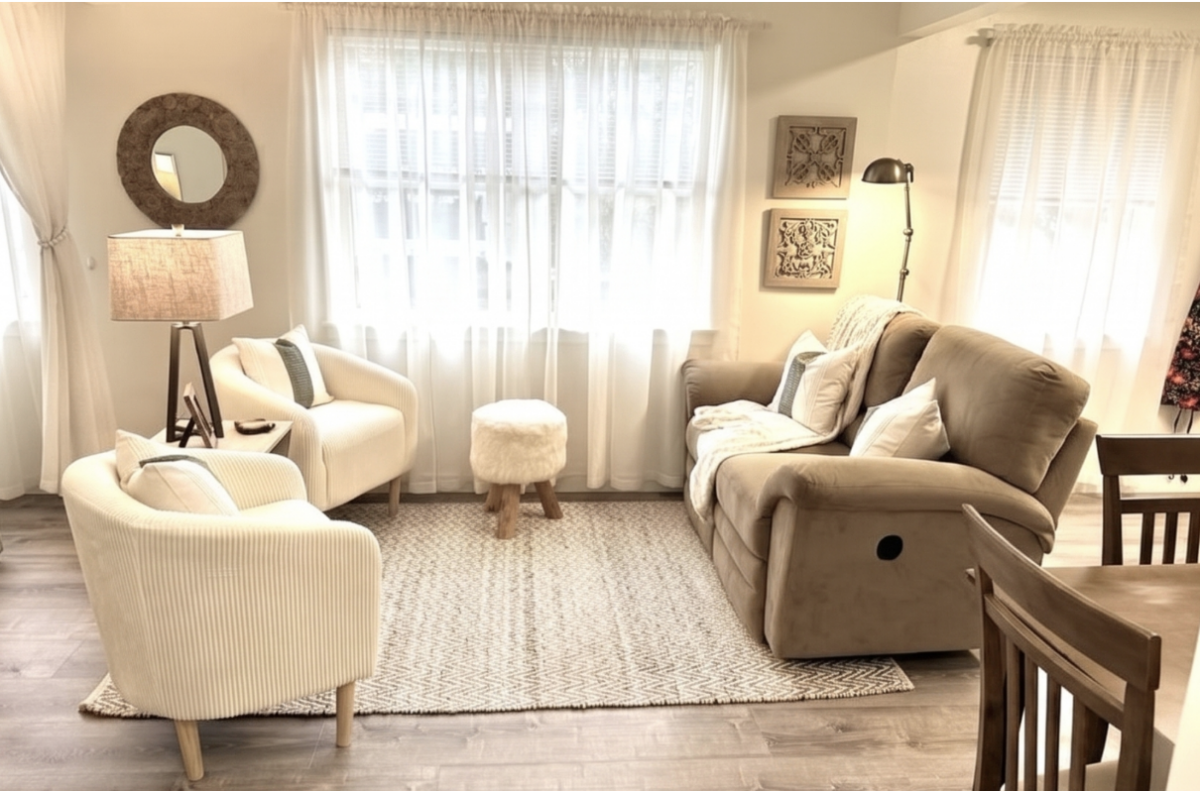
When a family emerges from crisis, the transition into permanent housing is often as daunting as the circumstances that led them there. Across Central New Jersey, when single mothers, families exiting homelessness or domestic violence, and individuals facing sudden crisis are able to secure permanent housing, they often come home to an empty apartment—with no funds left to turn bare rooms into a functioning home.
That is where hearts+homes steps in. Founded in 2020 at the height of the pandemic by Kristen Bowen, the idea for hearts+homes came about two years prior, after losing her parents in close succession. The nonprofit was born out of the broader family’s desire to know, without a doubt, that their donations of furniture and home goods that held memories and sentimental value would benefit someone in need. So, they created a nonprofit that does exactly that.
“Knowing your loved one’s belongings will benefit others helps provide comfort and closure after a significant loss,” says Bowen. “Like many other folks, I enjoy a fun trip to the local thrift store, but my siblings and I didn’t want to see our parents’ belongings sitting on a shelf. We wanted their belongings to directly help those experiencing a difficult season take brave steps forward.”
Six years later, hearts+homes’ mission remains unchanged. “We specialize in furnishing fresh starts. We provide beautiful, gently used furniture to families emerging from crises at no cost to them,” Bowen says. As a faith-based organization, our core values of Compassion, Generosity, Respect, Quality, and Service are the principles we’re built on.” Today, the organization furnishes fresh starts by providing turn-key home installations, doorstep furniture deliveries, and emergency starter kits.
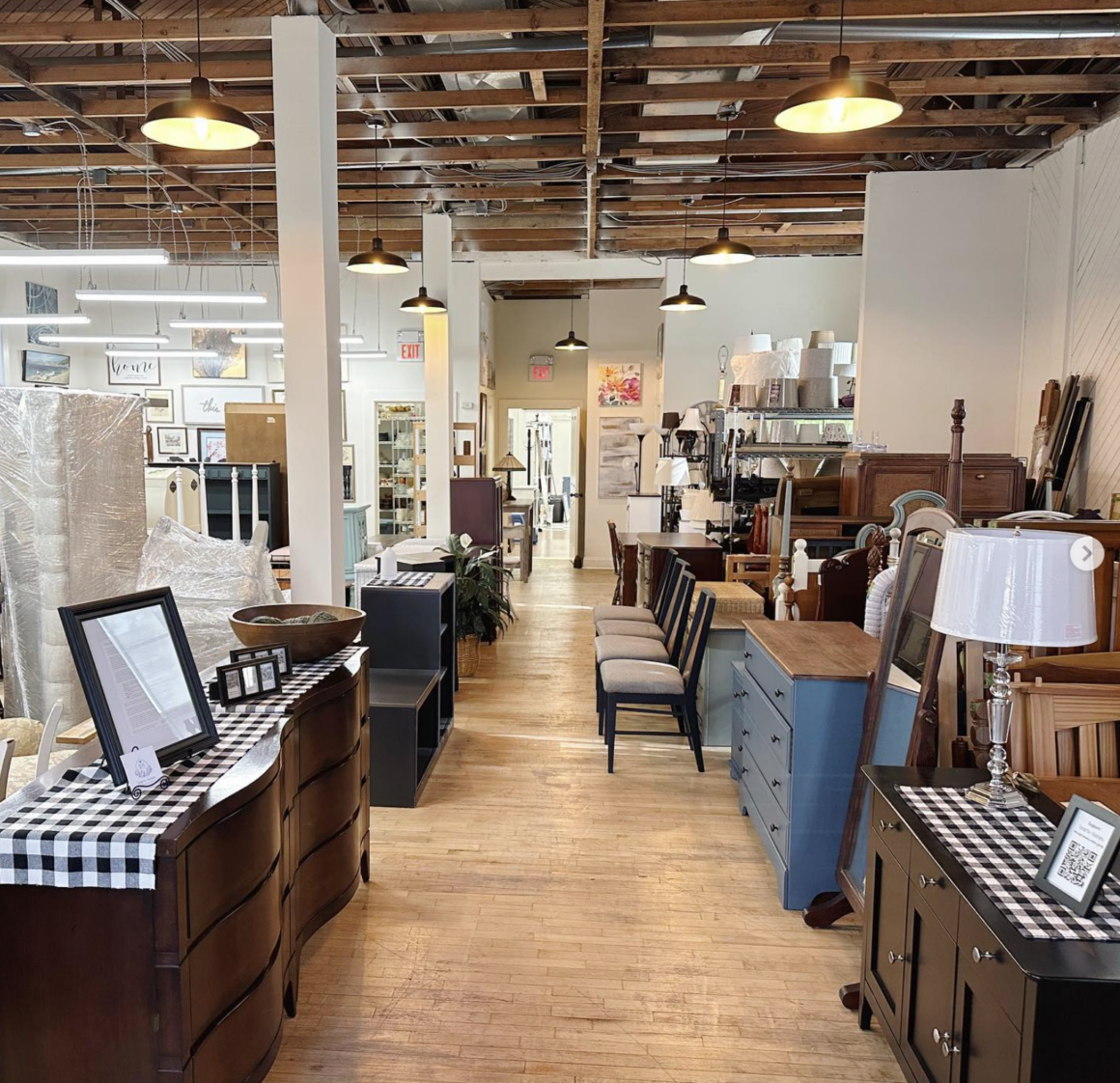
Before providing an installation, the team conducts intentional, in-person, home visits with each family to understand their story, personal preferences, color choices, and everyday lifestyle needs. They then pull from their inventory of home goods and upcycled furniture to completely design and furnish the home from top to bottom—turning what was previously an empty apartment into a beautiful, fully personalized haven.
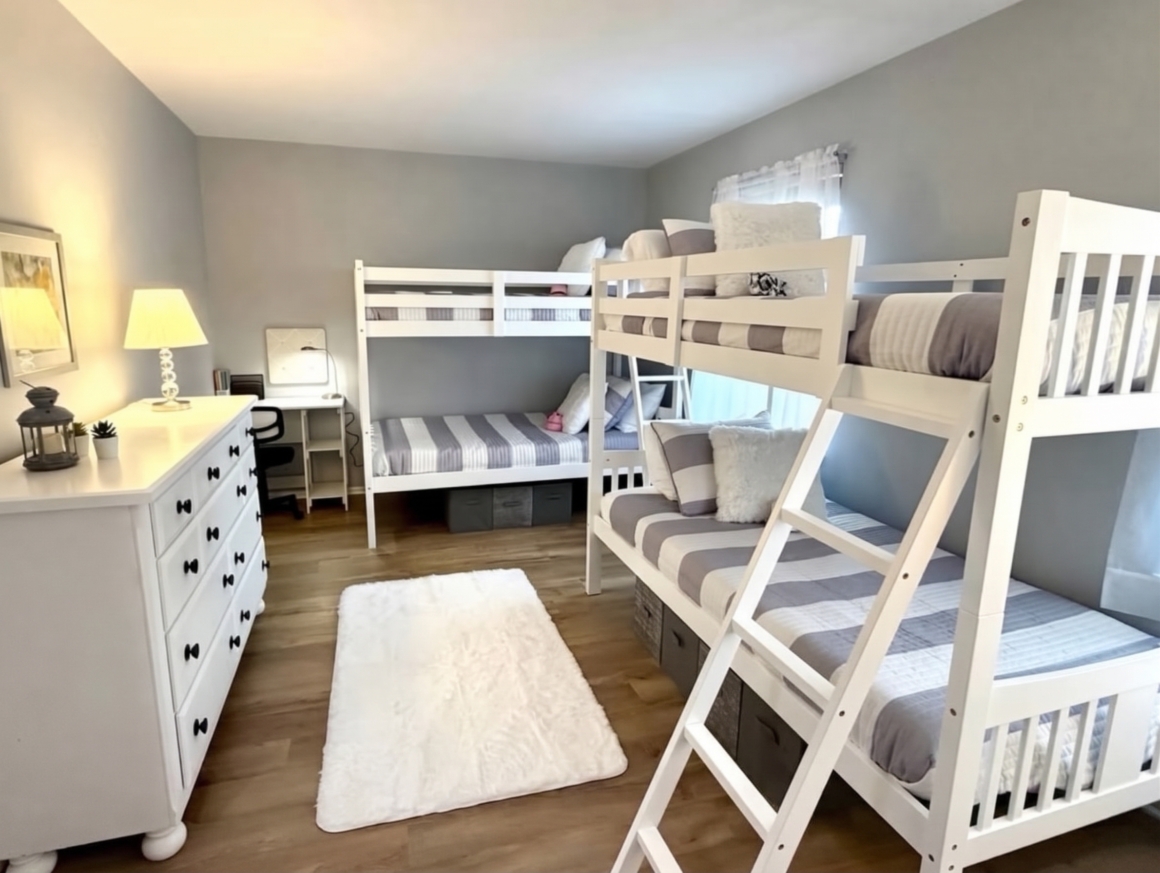
“We design spaces with a tremendous amount of care, and our volunteers ensure our Quality core value by refinishing, repairing, and sometimes even reimagining the furniture that’s donated to us. If we wouldn’t place it in our own home, we won’t place it in our clients’ home,” says Bowen. “Our goal is that the design doesn’t just feel like a home, but that it feels like their home… their personal space.”
Clients come to hearts+homes through a carefully cultivated network of professional advocacy partners made up of social services agencies, local churches, and community organizations. Those advocates champion the cause of the families in need of care, qualify them for services, and provide additional wrap-around care like counseling, career development, and supplemental food pantry services.
“We’ve never met a family that only needs furniture,” says Bowen. “Our partnerships have been a vital part of our success as we strive for a zero-return-to-original-crisis rate. We couldn’t do what we do without our partners.”
Behind every couch, lamp, and kitchen utensil moved into a family’s new living space lies a complex web of assets large and small, managed entirely by volunteers. To run an operation where intentionality and financial accountability are paramount, hearts+homes relies on Sortly as the operational backbone of its day-to-day work.
Moving beyond operations: Sortly as an operational enabler
For some organizations, inventory software is simply a back-office tool used to log items. For hearts+homes, Sortly is built into its mission.
“Sortly was the very first online application that we subscribed to,” explains Bowen. “We chose Sortly because we felt so strongly about the idea of being accountable to those who generously donated items to us.”
Because hearts+homes operates as a 100% volunteer-led and driven organization with 60 dedicated individuals managing everything from inventory and home visits to finance and home installations, every minute saved translates directly into broader community impact.
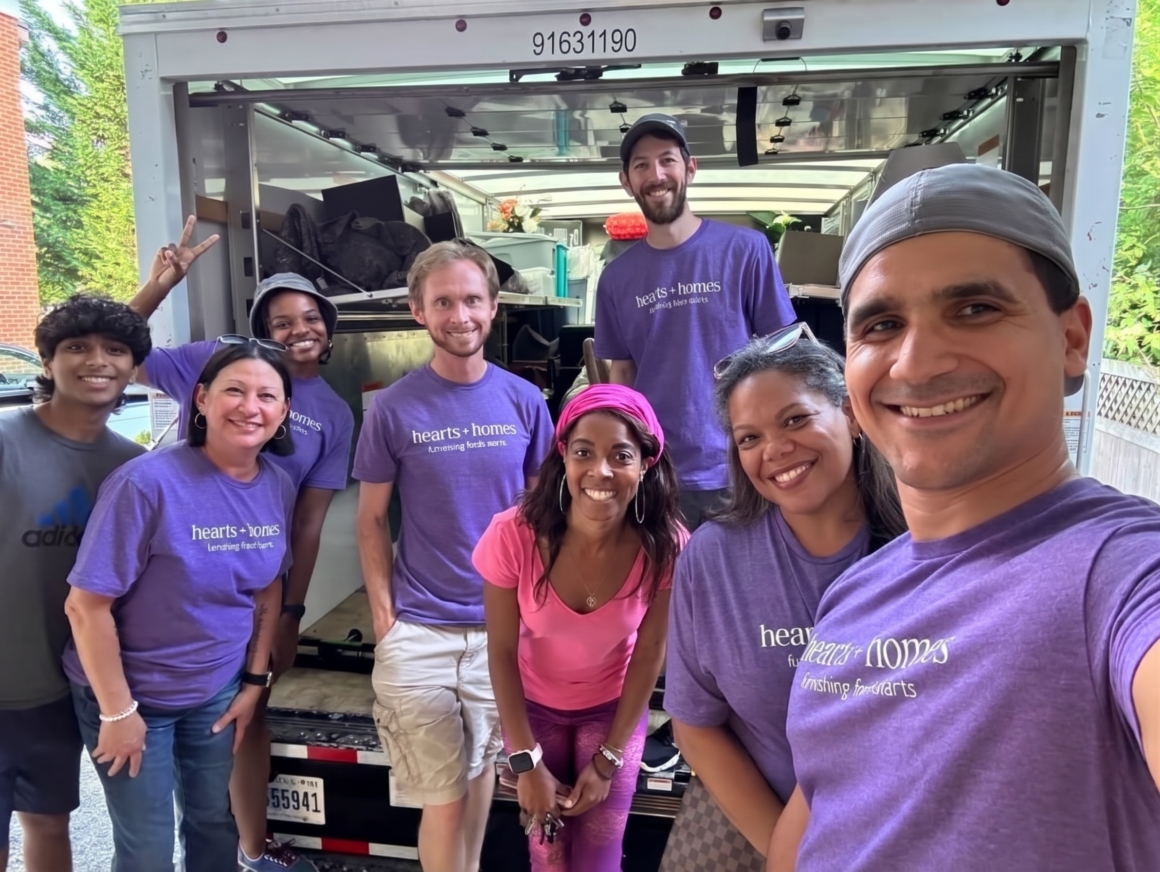
Respecting those volunteers means respecting their time above all else. “We don’t have paid staff, so we want to be respectful of their time, which is often their greatest resource,” Bowen notes. “For us, every minute a volunteer shares with us counts. Sortly allows us to be excellent stewards of our volunteers’ time and every piece of donated furniture that we receive.”
Sortly features that keep hearts+homes running
Unlike standard commercial businesses that manage thousands of identical items, virtually every single item donated to hearts+homes is unique. There is no margin for error—an item is either in stock or it isn’t.
To eliminate guesswork and streamline physical workflows across their primary workshop and two off-site, climate-controlled, storage units, the inventory team relies heavily on Sortly’s QR coding, custom fields, and high-capacity photo features.
High-resolution photos to document upcycling
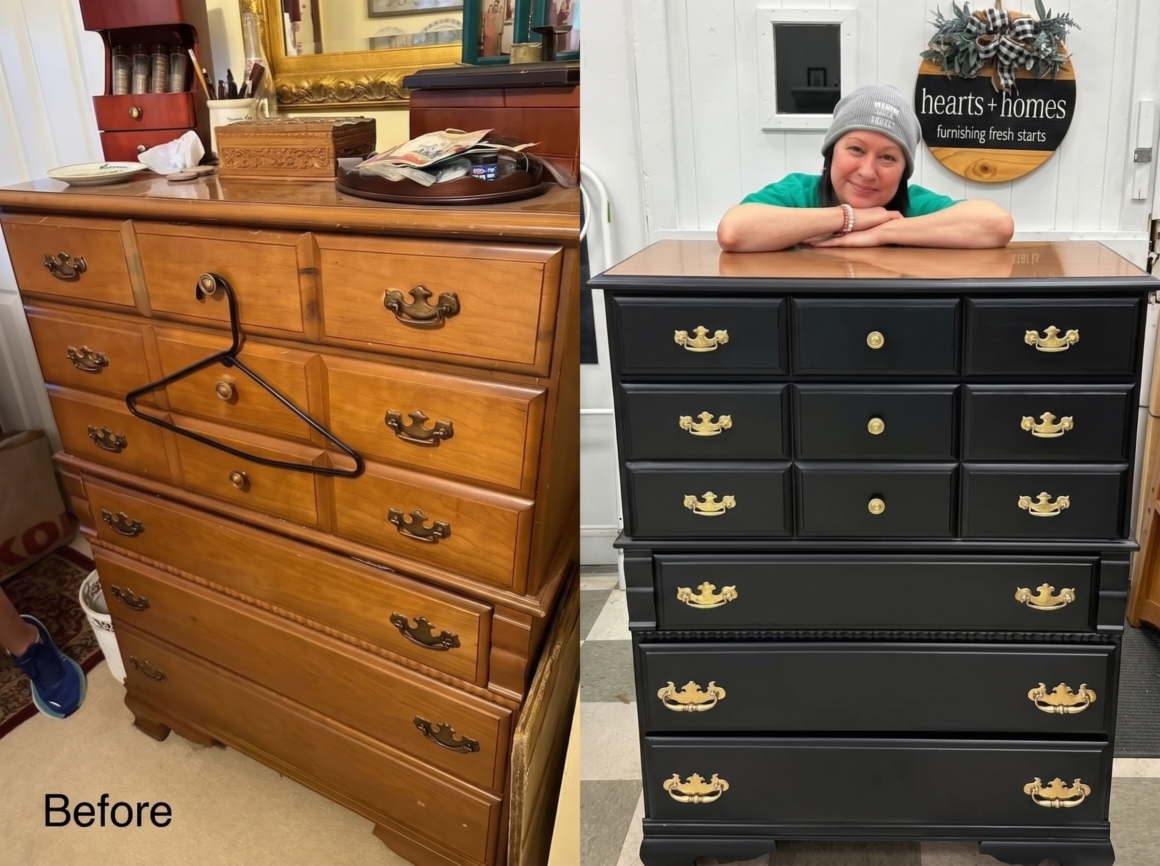
Sortly allows the team to upload up to eight photos per item profile, enabling them to capture every piece and document its evolution through upcycling.
“When an item first arrives at hearts+homes, a photo is taken of it in its current condition,” Bowen notes. “Once it’s been upcycled, we take a new picture of it, adjust the description, and adjust the value of it to reflect its fresh new look.”
These visual logs do more than maintain organized records—they fuel the non-profit’s community engagement. The team regularly pulls before-and-after photos from Sortly to share on social media, showcasing a piece’s incredible transformation before it reaches a family. They also send these visual updates back to the original donors, offering a heartwarming look at their item’s new chapter.
“Our donors get excited when we update them on their piece and let them know it’s ready to be shared with a family. There’s something encouraging to them about knowing their furniture will live on in a new household with a new family,” Bowen adds.
Notes and custom fields to track unique details
To manage its non-standard inventory, the team uses Sortly’s custom fields—flexible, customizable data fields that organizations can tailor to track any specific detail beyond basic metrics like quantity or SKU. Because hearts+homes handles unique, one-of-a-kind donations rather than mass-produced items, they adapted these fields to suit their distinct operational needs.
The team relies on Sortly’s custom fields and notes to log essential details for every item during its upcycle journey—including its fair market resale value, which increases once an item has been refinished. Volunteers determine accurate resale values to ensure proper internal accounting and asset reporting. “They’re quite good at estimating current values and resale market fluctuations. This helps ensure our end-of-year accounting properly reflects the value of all assets on hand as well as the value of what was shared during the course of the year,” says Bowen.
Beyond financial tracking, these custom fields also streamline day-to-day operations, down to logging the exact paint color used during upcycling. This allows volunteers building coordinated room designs to quickly identify complementary pieces without physically matching paint in cans in the workshop.
“When we refinish a piece, we log the paint color in Sortly,” explains Bowen. “That way, if we’re designing a room around that particular piece of furniture, we don’t have to guess which color we used. Instead, we can just note that the project’s color was, for example, Valspar paint in ‘Smoked Oyster.’ Sortly keeps a detailed profile of every piece of furniture.”
Barcoding and QR codes for perfect accuracy
In early 2026, the organization made a strategic decision to QR code all incoming inventory to maximize processing speed and accuracy.
“We made a commitment in 2026 to start QR coding everything, because it helps us more efficiently manage the coming and going of items,” says Bowen. “We no longer have to manually search Sortly to find something in the system… we just scan the attached QR code. It allows for pin-point accuracy. Plus, it’s an incredible time saver. ”
Mobile tracking for seamless collaboration—even across state lines
The flexibility of Sortly’s mobile interface does not just streamline physical inventory management—it directly supports the culture and people within the organization.
When a long-time inventory volunteer relocated from New Jersey to Texas, she wanted to remain active with hearts+homes. Because Sortly operates seamlessly on any mobile device in real time, the team was able to keep her fully integrated in day-to-day operations.
“She probably knows the system better than anybody else at hearts+homes,” Bowen shares. “Now, we just take a picture of the item and a picture of the QR code and text it to her. All she has to do is press the QR code in the picture, and it takes her directly to the item in Sortly.” This seamless mobile connectivity allows her to participate and update inventory as if she was standing on the workshop floor.
“If we didn’t have Sortly, that wouldn’t be possible,” says Bowen. “It allows us to maintain a relationship with a volunteer who had faithfully served with us for three years prior to her move. With Sortly, it’s as if she’s still standing right here with us.”
Furthermore, the mobile interface enables the team to “shop” available inventory remotely from a laptop or mobile phone, coordinating room layouts and consulting with social service caseworkers in real time to match specific dimensions and color palettes.
Financial excellence, stewardship, and audit readiness with Sortly
For nonprofits, demonstrating stewardship and transparency to financial regulators and donors is critical. Hearts+homes uses custom fields within Sortly to track fair market resale values, donor identities, receiving families, and disposition statuses.
The inventory hearts+homes tracks in Sortly is categorized logically into dedicated folders:
- Available inventory: Items on hand, available to be used in an upcoming installation or doorstep delivery.
- Placed inventory: Furniture that has been successfully delivered to a family, tagged with the recipient’s name and delivery date.
- Decommissioned & inconsistent inventory: Damaged or out-of-scope items that still need to be accounted for so every donation receipt generated can be fully reconciled.
This meticulous approach directly contributed to hearts+homes earning accreditation for financial excellence from the Evangelical Council for Financial Accountability (ECFA)—an honor held by only 50 nonprofits in New Jersey.
“Our ability to report on our furnishings as financial assets was a big part of gaining that accreditation. Sortly allows for the ever-important future audit where we can, again, be good stewards of what we’ve received.”
A mission rooted in intentionality
At its core, hearts+homes balances operational rigor with a deep commitment to human dignity. From tracking upcycled furniture transformations to placing personal notes from donors inside dresser drawers for new families to discover, every workflow is executed with care.
“As we serve others, it’s quality over quantity. It’s stories over statistics,” reflects Bowen. “We don’t rush through serving our families. We make sure they are well accommodated and their individual needs are met. That level of intentionality and the methodical approach that we take with our families is reflected in Sortly. We consider Sortly a service partner. It’s not just a subscription, it’s a relationship.”
By grounding its work in transparency, stewardship, and deep care for every family served, hearts+homes proves that with the right foundation in place, standard operations can transform into an extraordinary community mission. If your team is looking to simplify asset management and keep the focus on the work that matters most, learn more about how Sortly empowers nonprofits and explore how Sortly can streamline your daily operations through better inventory and asset tracking today.


